
Mechanical Systems and Emotional Stability

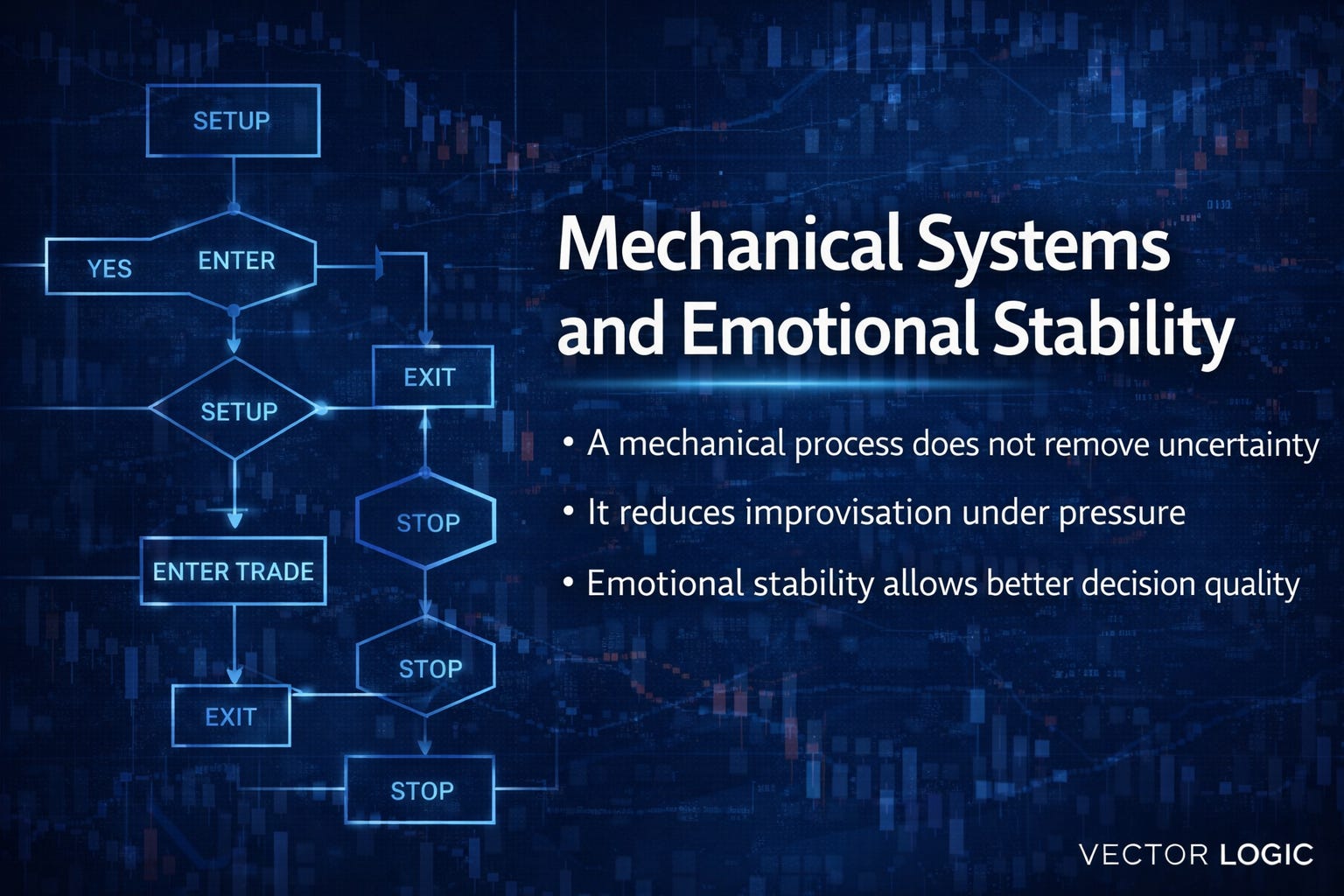
One of the biggest misunderstandings in trading is the idea that emotion can be solved through willpower alone.
People talk about mindset, discipline, confidence, patience, and self-control as though the answer is simply to become mentally tougher. As though the trader’s main job is to feel less, react less, and somehow stay calm inside an environment designed to provoke reaction.
That framing sounds sensible. It is also incomplete.
Most emotional instability in trading is not just a psychology problem. It is a process problem.
If the method is vague, if the risk is inconsistent, if the rules bend under pressure, or if too much judgement is being improvised in real time, then emotional interference is not some surprising weakness. It is the natural output of a loose decision-making structure.
A trader cannot expect stable behaviour from an unstable process.
That is why mechanical systems matter.
Not because they make trading easy.
Not because they eliminate uncertainty.
And not because they guarantee good outcomes.
They matter because they reduce unnecessary decision noise.
A mechanical process defines in advance what matters, what qualifies, what does not, how risk is set, and what happens after entry. It creates structure where many traders otherwise rely on mood, recent outcomes, or moment-to-moment interpretation. That does not remove losses. It removes a great deal of self-inflicted randomness.
That distinction matters.
Markets already contain enough uncertainty on their own. Price can still fail. A clean setup can still lose. A strong thesis can still be invalidated. The trader does not need to add another layer of instability by changing standards halfway through the trade.
Yet that is exactly what happens when the process is loose.
A trader enters on one logic, manages on another, exits on emotion, and then reviews the outcome as though it all belonged to one coherent system. It did not. It was part method, part feeling, part recent memory, and part discomfort management.
That is not execution.
That is improvisation under pressure.
And pressure changes behaviour fast.
Fear cuts winners early.
Greed delays exits.
Frustration forces marginal setups.
A recent loss creates hesitation.
A recent win creates looseness.
Without a structured framework, the trader is constantly exposed to these distortions. The result is not just emotional fatigue. It is degraded decision quality.
This is where mechanical thinking becomes protective.
A sound system does not ask the trader to rediscover the rules every day. It does not require a fresh internal negotiation every time price starts moving. It narrows the decision space. It turns execution into a repeatable act rather than a live debate between logic and feeling.
That is why consistency improves.
When the same filters are applied repeatedly, trades become comparable. Review becomes more honest. Weaknesses become visible. Strengths become measurable. A trader can actually tell whether the method is working, because the behaviour around it is stable enough for the data to mean something.
That is impossible when execution changes with mood.
This also has a direct effect on emotional stability itself.
The less a trader has to improvise, the less psychological friction each trade creates. There is less second-guessing. Less internal bargaining. Less temptation to turn discomfort into a reason to abandon structure. That does not make trading emotionless, but it does make it more governable.
And that is usually the real goal.
Not to feel nothing.
To stop emotion from being given operational control.
A mechanical process helps do that because it moves key decisions upstream. The harder thinking happens before the trade, not during the moment of pressure. Standards are set before urgency arrives. Risk is defined before price starts moving. Behaviour is guided by structure rather than by whatever feels persuasive in the moment.
That is closer to professional decision-making.
Professionals do not win because they are perfectly calm. They win because the process does more of the stabilising than the personality does. They do not rely on being in the right mood. They rely on systems that keep behaviour aligned when mood becomes unreliable.
That is a much stronger model.
Of course, no system should become mindless. Mechanical does not mean blind. Markets still require interpretation, context, and judgment. But judgment works best inside a structured framework, not in place of one. The role of the framework is not to replace intelligence. It is to stop intelligence being hijacked by noise.
That is the deeper value.
A mechanical trading process is not only a way to manage trades.
It is a way to manage the trader.
Because in the end, inconsistent execution usually looks like a market problem from the outside. But from the inside, it is often a structure problem. Too many live decisions. Too much room for drift. Too little separation between process and feeling.
The solution is not to become superhuman.
It is to become more structured.
Emotional stability in trading is rarely built by telling yourself to be calmer.
It is built by designing a process that asks less of emotion in the first place.