
Why More Market Information Does Not Create Better Traders

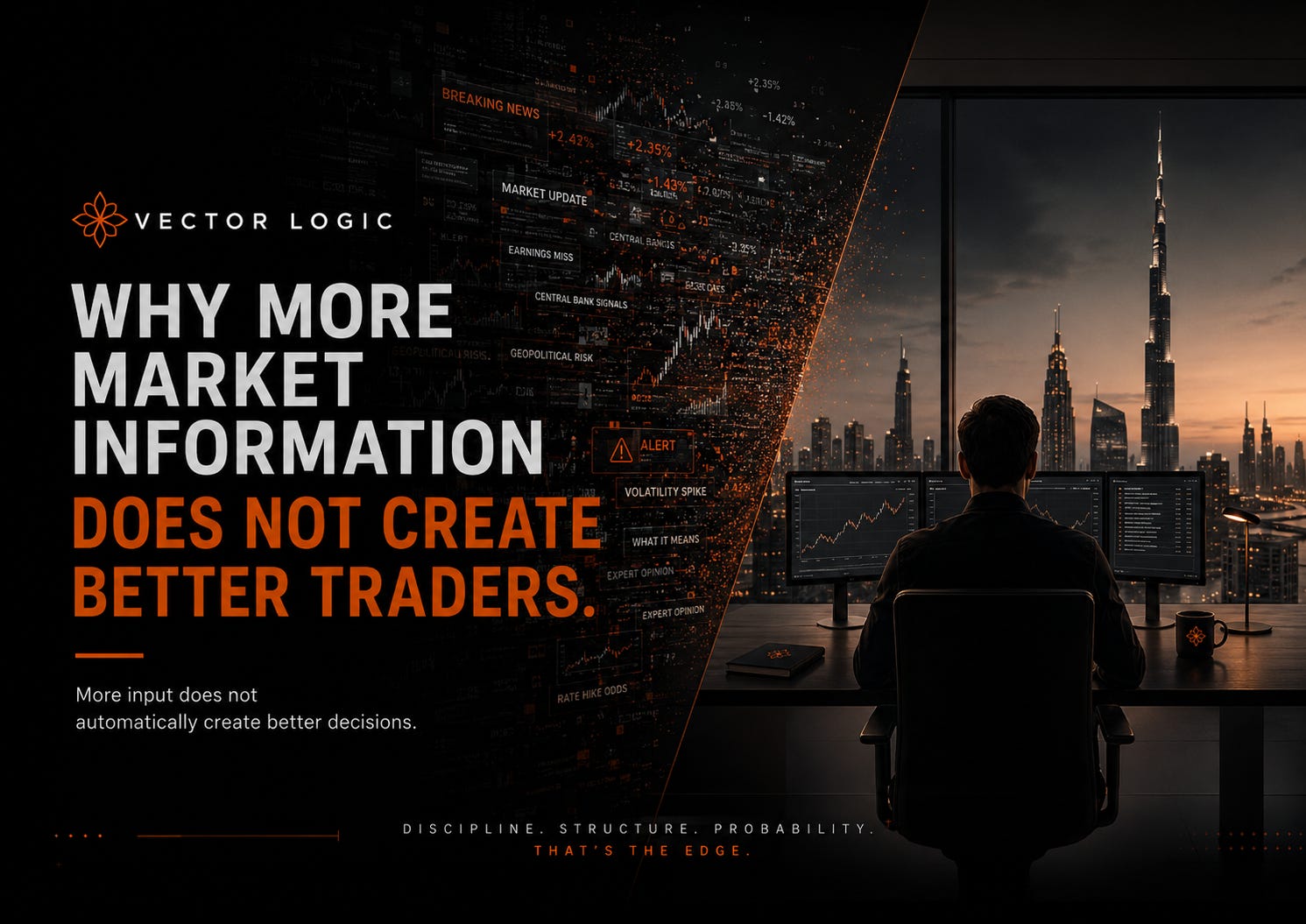
More market information does not automatically create better trading.
That sounds wrong at first. More charts, more commentary, more data, more perspectives. Surely more input should mean better decisions.
In practice, it often does the opposite.
Most traders are not short of information. They are buried in it.
Price feeds.
News.
Social media.
Threads.
Charts.
Alerts.
Macro takes.
Technical takes.
Opinions from people who sound certain about things that are not certain.
The modern trader’s problem is rarely scarcity.
It is excess.
And excess has a cost. It makes people feel informed while making their actual decision-making less clear.
Information and judgment are not the same thing.
A trader can read good analysis and still take a bad trade. They can listen to smart people, understand the argument, and still lower their standards at the point of execution.
The issue is not whether information exists.
The issue is whether the trader can filter it.
That is the harder skill.
More input often feels like progress. You are watching, reading, updating, refining. It feels active. It feels serious.
But sometimes it is just a cleaner-looking version of hesitation.
You are not improving the process.
You are delaying the point where a decision has to be made.
This is where information becomes dangerous.
Not because information is bad, but because unfiltered information erodes signal. Everything starts to carry the same weight. Useful ideas compete with interesting noise. Strong market conditions become harder to recognise because the trader is reacting to too many inputs at once.
And “interesting” is a trap.
Interesting charts are everywhere.
Interesting opinions are endless.
Interesting explanations can be built around almost any move.
But trading performance does not come from collecting interesting things.
It comes from making clean decisions under uncertainty.
That requires a process strong enough to reject most of what passes through your field of view.
Good traders are usually not trying to absorb everything.
They are trying to stay close to what matters:
Structure.
Risk.
Conditions.
Behaviour around key levels.
Whether the setup is actually there.
Whether the process is still intact.
That work is narrower.
Less exciting, maybe.
More useful.
The problem with constant input is that it can slowly replace process. Enough commentary creates the feeling that there must be a trade. Enough narratives make sitting still feel like doing nothing, rather than doing the right thing.
But markets do not pay for being plugged in.
They do not reward you for seeing everything.
They reward selective participation under controlled standards.
A strong process needs filters:
What matters here?
What changes nothing?
What is noise?
What genuinely improves the read?
What is just feeding urgency or bias?
Those questions are more valuable than another feed, another opinion, or another chart.
A smaller number of strong inputs, combined with a clear framework, will usually beat unlimited exposure.
The edge is not in hearing the most.
It is in needing less to make a clean decision.
That does not mean becoming closed-minded. It means becoming selective. Inputs should serve the framework, not replace it.
Many traders keep adding information when what they really need is structure.
They widen exposure when they need sharper judgment.
They chase more market understanding while ignoring the better question:
Are my decisions getting cleaner?
That is the real test.
Not how much you know.
Not how much you consume.
Not how much market content passes in front of you.
Whether your standards hold under pressure.
More information does not automatically create better traders.
Often the real improvement comes when the trader stops collecting so much, filters harder, and lets clarity do the work that noise never could.