
Why Most Traders Study the Wrong People

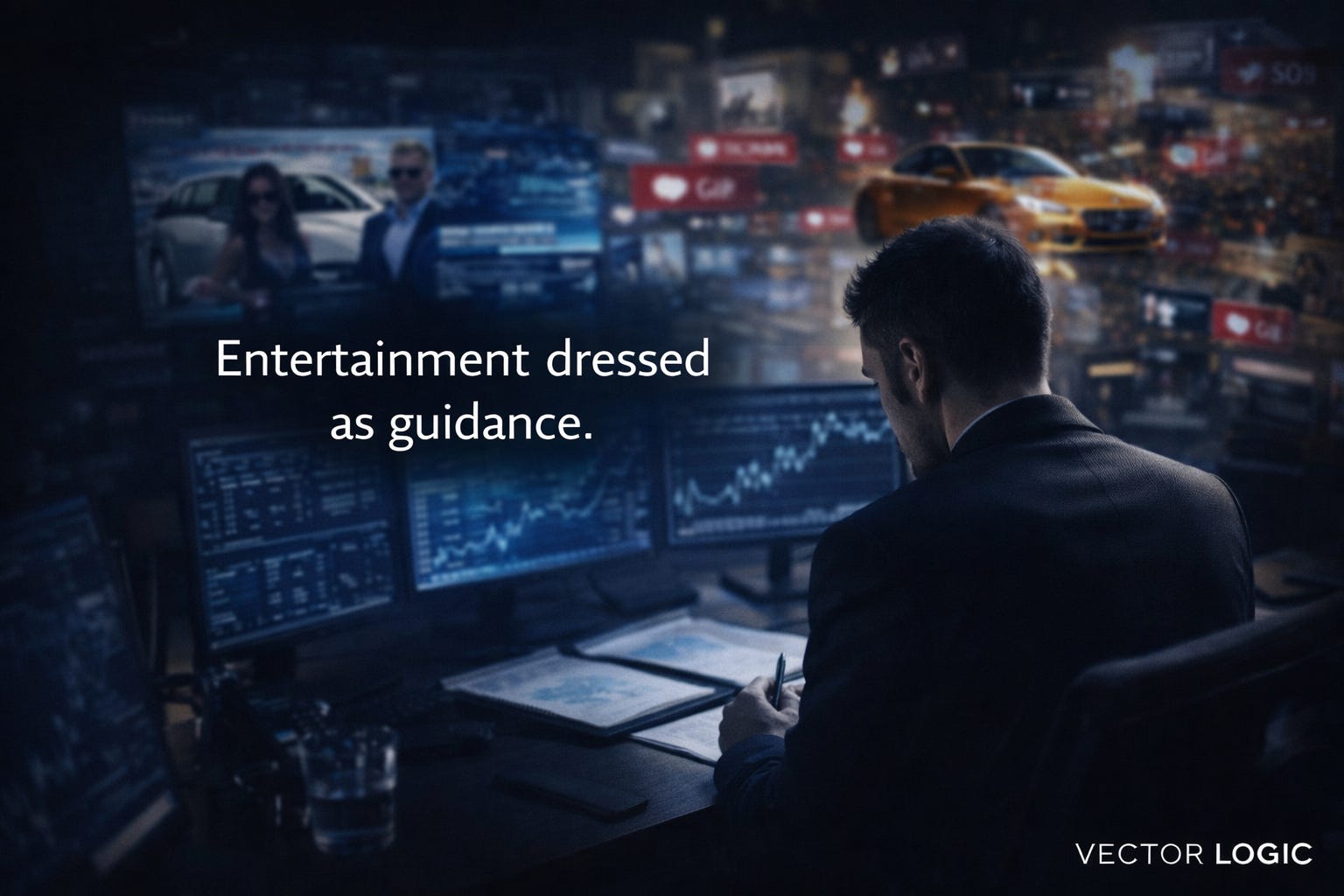
One of the stranger things about trading is that information has never been more available, yet serious learning is still surprisingly rare.
Charts are everywhere.
Opinions are everywhere.
Threads, clips, screenshots, “lessons”, hot takes, market calls, lifestyle posts — endless.
So on the surface, it looks as though modern traders should have an advantage. Everything is accessible. Everything is searchable. Everything appears to be one click away.
But access to information is not the same thing as access to good models.
And that is where many traders go wrong.
They do not just struggle with the market. They struggle with who they choose to learn from.
Again and again, people ignore the larger, more disciplined, more proven operators and instead fixate on someone unverified, loud, visually impressive, and socially persuasive. Someone with a timeline full of glamour, certainty, and performance theatre. Someone who looks like trading success should look in the imagination of a beginner, even if very little about their behaviour reflects serious process.
That is not a small mistake.
Because trading is learned partly through explicit knowledge, but also through imitation. People absorb what gets repeated. They start to copy tone, pacing, priorities, reactions, and standards. They begin by consuming content, but over time they are really consuming behavioural models.
That matters.
If the model is thoughtful, restrained, process-led, and honest about uncertainty, that influence can help. It can pull a trader toward better questions, better habits, and cleaner standards.
If the model is noisy, theatrical, ego-driven, or built around image rather than substance, the influence still works. It just works in the wrong direction.
And that is what many people miss.
The danger is not only bad information. The danger is bad example.
A trader might tell himself he is only watching for ideas. In reality he is also absorbing what deserves attention, what counts as progress, what good trading is supposed to feel like, and what success is supposed to look like.
That is why this matters far beyond simple “education”.
If the examples around you are built on bling, speed, flexing, and the constant performance of certainty, you will quietly start drifting in the same direction. Not necessarily because you believe it all intellectually, but because repeated exposure changes what feels normal.
Soon the hard work starts to look boring.
Restraint starts to look weak.
Patience starts to look passive.
Quiet competence starts to look invisible.
And theatre starts to look like expertise.
That inversion does real damage.
Because the actual job is harder and less glamorous than most people want to admit.
The real job is learning the market and learning yourself.
Learning how conditions behave.
Learning where structure matters.
Learning what good risk feels like.
Learning how your own impatience distorts judgment.
Learning what happens to decision quality when ego, boredom, fear, or excitement take over.
That work is not especially photogenic. It does not create a flashy timeline. It rarely looks impressive from the outside. But it is where real progress comes from.
Serious traders eventually understand that learning is not just about collecting more market opinions. It is about getting closer to disciplined thinking. Closer to clean process. Closer to people whose behaviour reflects durability rather than display.
That does not mean only listening to famous names or large institutions. Plenty of people with reach are useless, and plenty of sharp thinkers operate quietly. The point is not status for its own sake.
The point is standards.
Who is actually serious?
Who is process-led?
Who respects uncertainty?
Who sounds grounded in work rather than image?
Who makes you think more carefully instead of react more quickly?
Those are better filters.
Because in trading, the examples you keep around you shape the trader you become.
If you repeatedly study people who make the business look glamorous, impulsive, and socially performative, you will struggle to build something robust. If you study people who make it look disciplined, sober, and hard-earned, you give yourself a better chance.
That is not about hero worship.
It is about environmental quality.
And environmental quality matters because most traders are not only fighting markets. They are fighting imitation, distraction, ego, and the constant temptation to prefer exciting signals over serious ones.
Information is everywhere.
Serious example is not.
That is why learning behaviour from the right people matters.
Not because they can do the work for you.
Because they can stop you admiring the wrong version of the work.